Right, so I've made it as far as Munich with only a few minor hiccups (Luik & Lieges are the same place it seems).
Whilst I'm here I just wanted to push anyone with an interest in Patrick Leigh Fermor in the direction of this blog. My post from below went live today and an interesting discussion on the merits (or not) of guidebooks is developing.
Monday, July 23, 2012


Sunday, July 22, 2012
I seem to know a fair few people that walk across Europe, so just setting off to drive to Greece seems a bit lazy. Still, I'm on a deadline and work beckons. In three hours time I'm setting off to spend the summer in the Peloponnese, researching the new edition of my guidebook. I'm getting to the continent on the Eurotunnel and then driving to Munich, hoping to arrive some time Monday afternoon. The rest of the family is flying there and spending a week with relatives before flying on to Greece. I head on again early the next morning, south into Italy where I will get the ferry from Ancona. A night crossing the Adriatic takes me to the northern Peloponnese by Wednesday afternoon. From there it's a relatively short 4.5 hour drive down to the Mani where a meso-kilo of rosé awaits. I'll update and write more whenever I can.
Tuesday, July 17, 2012
It's been a long gap, but I'm just off to Greece for 6 weeks and hope to have a bit more time to post. I'll be updating a guidebook, but thought I'd start with a quick explanation of how I got to love Greece in the first place, and also to mention, as promised ages ago, a bit more about Paddy Leigh Fermor:
There are people who always seem to be fated to
end up in their eventual career; children whose endless games of doctors and
nurses or Lego translate into later careers in medicine or engineering. I used
to think that I didn’t fit into this category, but now I’m not so sure.
In
a week’s time I head out to the Peloponnese, the southern mainland of Greece,
to complete the research to the second edition of my guide to the area, due to
be published in early 2013 by the award-winning publishers Bradt. The first
edition was written whilst I lived in the area, and whilst my daughter, who was
born in Kalamata, grew up. Now I’m heading back for six weeks to show her where
she comes from, and to introduce her one-year-old brother (middle name
Telemachus) to the country.
How
I ended up doing this seems to be due to huge smatterings of good luck and
coincidence; but thinking about it there was an element of fate involved. This
was mainly due to my mum, who instilled in me an early love of Greek mythology
and history. It was also on her shelves that I first found the books of Paddy Leigh Fermor. I must have been about 14 at the time, and I devoured them. This
quickly led to backpacking trips round Greece, sleeping in olive groves and
abandoned tower houses, and eventually working there as a teacher, tour guide
and writer.
Fate
continued to intervene and my small family ended up living in a house on the
headland above Kalamitsi bay, where Paddy had built his beautiful Greek house.
In truth I had never really wanted to meet him, expectations are too easily let
down, but in the end it seemed inevitable. He turned out to be just as affable,
engaging and generous as the books would lead you to think.
He
wasn’t really that keen on the idea of a guidebook to the Peloponnese, and I do
see his point; but it was his books that guided me there. I think that if
people are to travel, then a least they should travel with knowledge and
understanding.
I’m
pretty proud of my book, and hope to spend the next few weeks making it even
better.
Thursday, November 18, 2010
This is worth a look . . .
Sorry for the lack of posts; I'm very busy right now, but hope to resume soon. In the mean time check this out:
It's not what you think . . .
Actually she's doing a bit of physics.
More info here.
Thursday, September 23, 2010
Natural Wonders of the Peloponnese
Continuing my series of lists of favourite places to visit in the Peloponnese, I thought I’d tackle a few of the natural wonders of the area. The big omission from this list is beaches, not because they’re aren’t any – far from it – but because I thought they deserved treating separately. I also thought it was worth pointing out that these lists are by no means exhaustive; there is far more to the area than I can go into here. As always, if you want further information I can only humbly direct you towards my guidebook – see the link on the right of this page.
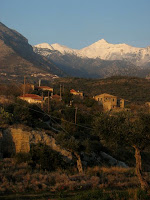


 Hidden up in the mountains this ‘lake’ rarely has water in it these days. Instead a sea of reeds covers the flat plain, catching the light as they sway in the breeze, and the surrounding peaks hover in the clouds above. A ruined Frankish abbey completes a Gothic picture that most would never associate with Greece. They should do more exploring . . .
Mount Profitis Ilias

There are hundreds of mountains named after the prophet Elijah in Greece (he ascended into heaven from the top of one), but this must surely be the highest. At 2,404m it is also the biggest mountain in the Peloponnese and can be capped with snow from November to May. Given this it is actually not that hard to reach the summit, most easily from a mountain refuge above Sparta. On the 20 July, Elijah’s name day, this lonely height attracts quite a crowd.
Polilimnio

The ‘many lakes’ that make up Polilimnio come as quite a surprise in a land where most rivers run dry during the summer. They are a series of pools formed by the river Kalorema (‘Beautiful Stream’) as it runs through a gorge. If you can find them, and are prepared to do a bit of walking, they provide an idyllic spot for a cooling dip and a picnic.
Viros Gorge

Stretching up above the village of Kardamyli on the Mani coast this spectacular gorge provides some tough, but rewarding, hiking. Those bold enough to attempt it will be surprised to find hidden monasteries in its depths, once well populated by monks.
Mesa Mani

The ‘Deep’ Mani is a barren, rocky, mountainous spit of land, that would normally offer little of attraction. For some reason, however, it exerts a sublime and magnetic force on the traveller. The fact that this was once the entrance to the kingdom of Hades, Lord of the Underworld, comes as little surprise.
Stymfalian Lake

Saturday, September 4, 2010
The perfect Greek salad . . .
When I first lived in Greece, when I was in my early twenties, it took me a while to figure out how to shop for groceries. My first point of call, the local supermarkets, seemed to stock nothing but canned goods. Eventually exploration turned up the bi-weekly open-air market, as well as various grocers and butchers. My problems hadn’t ended, however, as rather than nice plastic bags of perfectly spherical tomatoes I was presented with piles of huge, knobbly, bruised, fly-infested, reddish-green balls. Imagine my surprise when they turned out to be delicious. Times have changed, and now supermarkets contain fresh, local products, but the ethos behind Greek food remains the same.
In fact this is the simple secret to good Greek food. The ingredients are local, and recently picked or slaughtered. Nothing is processed and nothing has travelled far to your plate. The measure of this is to compare a horiataki, the famous Greek salad, prepared in a tiny village taverna, to one made with M&S finest back in the UK.
There are as many versions of horiataki as there are villages in Greece, and endless arguments can take place over what should, or should not, go into one. I tend to think that they should be as simple as possible, letting the ingredients speak for themselves. Here’s my version, taken form my Peloponnese guidebook:
Halve a clove of garlic and wipe a bowl with the fresh flesh and discard. If you have a cucumber with thick skin (common in Greece) then slice much of it off, but don’t be fussy. Slice in half lengthways, and then into quarters. Holding these together cut into slices. Cut two or three large, Greek, tomatoes into bite-size chunks any old how. One large red onion diced up. I like to crumble my feta over, but will not complain if you like yours in large slabs. The feta should be chosen with care from the large selection at any Greek supermarket. Sprinkle on a couple of handfuls of Kalamata olives. And that’s it for major ingredients -- no peppers, and certainly no lettuce.
Now the important part: the dressing. This is very scientific. Take a bottle of this year’s local olive oil and put your thumb so it covers about a third to a half of the opening. Then pour over the salad moving the bottle in three circles; not too fast, but not too slow either. Take a bottle of red wine vinegar and close off the top a little more this time. Do just one circle. Finally sprinkle on half a handful of dry oregano from the nearest mountains. Do not toss the salad, the flavours will mix on your plate. Eat with Greek bread baked that day.
I hope you enjoy it, but you’ll obviously have to go to Greece for it to really work! If you disagree with my version, or have any improvements, do comment below.
Thursday, September 2, 2010
What do you call alternative medicine that works?
So let’s talk about homeopathy. Not because I particularly want to, but because it’s an instructive example of the kind of mass ignorance and self-delusion that I find distressing. (I had to think hard about the last word in that sentence; stuff like this is liable to make me angry, but that’s not a very useful emotion, so let’s settle for upset).
To begin with we need to clear up a widespread misconception that, while understandable, is hugely unhelpful if we are ever to come to an intelligent conclusion on this subject. Many people, when they hear the term ‘homeopathic’ used in relation to medicine, equate it with loose terms such as ‘alternative’, ‘natural’ or ‘herbal’. I call these ‘loose terms’ because they have no set, or generally agreed, definition. This is not true of homeopathy, which refers to a very specific set of ideas and beliefs, set out by a German doctor in the first half of the 19th century.
What are these beliefs? One central idea is that a substance that provokes a symptom similar to that of a particular disease, would also act as a cure for that disease. Another is that the process of succussion can vastly improve a medicine’s power (if you’re interested succussion basically means ‘shaking the bottle’). I’m going to ignore both these premises and concentrate on another central idea of the homeopathic system.
Homeopaths refer to this tenet as the Law of Infinitesimals. This declares that once you have an effective medicine, you can increase its power by diluting it. This deserves dwelling on. Homeopaths believe that the less you have of something the stronger it becomes. This means that as you add water to your squash it tastes progressively more orangey. Or that if you want to get really smashed you should have more tonic and less gin. Makes perfect sense to me.
This idea is then taken to its absolute extreme. Once homeopathy has identified a ‘medicine’ they take this substance and dilute it to a level where a bottle of it would not contain a single atom of that active ingredient.

If this sounds a bit ridiculous, that’s because it is. Yet in the UK we have NHS-funded homeopathy. That means our tax money is going towards something based on an idea that my four-year-old would see the holes in.
What do you call alternative medicine that works?
Subscribe to:
Posts (Atom)